Sunday, 24 March 2013

'Lincoln' - Movie Review

Lincoln was first released in November - I'm only seeing it at the movies some four months later. Sigh.

"I never, ever felt that depth of love for another human being that I never met. And that's, I think, probably the effect that Lincoln has on most people that take the time to discover him... I wish he had stayed [with me] forever." - Daniel Day Lewis
 
I'm frequently reminded of my childhood when I watch movies, and while watching Lincoln I had another trip down memory lane. 

There I was as a young boy staring at a book I had received from my parents for my birthday. In the book there was a chapter entitled, Honest Abe. It tells the story of how Abraham Lincoln worked as a store clerk but one day realised he had charged a customer a few cents more than he should've. So - what did the young Abe do? Well, judging from the title of the chapter he didn't shrug and stash the money. No, Abe closed the store and walked "miles" to where the customer lived to pay the correct change. 

In Steven Spielberg's Lincoln we not only witness this morally upright "Honest Abe" (who it seems wasn't above bribery, twisting arms and manipulation in the name of ending slavery!), but also the deconstruction of a longstanding myth that President Lincoln and the victorious North were above reproach. 

And if Lincoln was not reflecting a mythical construct then it certainly wasn't following the typical biopic plot structure either. Spielberg and Kushner manufactured a 500 plus page script which reflects on the last four months of the President's life, rather than the typical childhood to adulthood, rags to riches, story. It doesn't include any flashbacks, nor any "I remember when..." moments. Even the family issues surrounding the Civil War, the death of Willie Lincoln and Mary Lincoln's breakdowns (Mrs. Lincoln would eventually be sent to the "mad house" by her son Bobby) are not climatic parts of the film, but rather they add emotion, insight and depth to the central issue of the 13th Amendment and ending the war on Lincoln's terms. 

Judging by the chatter surrounding the film, it has been astonishing for many to learn of the opposition Lincoln faced within his own party surrounding the 13th Amendment and slavery. Even the American people were conflicted when it came to slavery and the Civil War. The early scene, where Mr and Mrs Jolly (who were anything but jolly) arrive at the White House to petition the President, perfectly sums up the popular view towards the war and slavery. The majority of people wanted an end to the war and weren't overly concerned if that end was met by the continuation of slavery. (We need to remember that slavery had been justified and, for the South, offered economic prosperity. Lincoln was morally against slavery but he also knew that the war mustn't end unless it is accompanied by the end of slavery. If the southern 'rebel' states joined the union before the amendment was passed then there would certainly be no end to slavery. And with the end of slavery came the end of southern economic power.)

So, how is it that a man who received only one years worth of proper education rose to these heights and held borderline radical views? That's a question worth contemplating. I suspect Lincoln's views came from his self education - he educated himself through the constant reading of the classics. This important image of the self-taught man emerges early and often in the film. This is done as the socially unpolished president quotes from books and seeks to tell parables and stories to explain his vision and take the edge off the enormity of the situation leading up to the end of slavery, war and ultimately his life. 

All too perfect an opening scene - this is the sort of thing national identity is constructed on!

However, while the film endeavours to tell the truth behind a dark political standoff in America, the opening scene of the film is one which is likely the furthest thing from what really happened. Yet this scene (where two black soldiers consult the president and the Gettysburg address is recited to the President between black and white soldiers) symbolises perfectly the moral fight behind the film. It's also a scene which will either leave a cringe worthy taste in your mouth, or will make you invest heavily. And if you are in support of the latter then you'll give a fist pump when the Amendment is finally passed (that shouldn't be a spoiler alert for anyone!) and feel tears when Thaddeus Stevens hands the amendment to his mistress. It's interesting to note that Thaddeus did actually have a black mistress but it's highly unlikely he was able to take the amendment home to show her! It’s a nice touch though.  

Believe it or not Tommy Lee Jones works as Thaddeus Stevens, the radical Republican demanding equality on all measures and the vote for all citizens. Tommy really does bring it all to the table in this one. He’s grumpy but oddly lovable and he's able to jabber and trash talk even though he has the stiffened face of an arch conservative. Yes, when it comes to radical emancipator he's got my vote! And the darnedest thing about it all is that he looked like he was having a ball out there.


Same stone-wall face, same awful wig.


Sally Fields apparently had to petition Spielberg to get an audition for this one! (Apparently they thought she was too old for the role.) And if that doesn't make you scratch your head then this will: Daniel Day Lewis wasn’t the original Lincoln, Liam Neeson was. Then again Neeson had played Oscar Schindler under Spielberg, but dropped out of Lincoln after years of research and preparation because he felt he was too old for the role. And if you believe the rumours then Lewis also wanted to quit the role at one point. But I digress, Sally Fields was made for the role of Mrs. Lincoln. You'll have to excuse my love for Forrest Gump's "Mama", but we all know she can throw down an emotional shitstorm of epic proportions. Her hysteria and emotional instability as Mary ("Molly") Lincoln constantly worries her husband as it does us. Was your bottom lip also trembling when she yelled at her husband and swore revenge if her eldest son should die in the war? Or when she told her President husband that he should've thrown her in the "mad house"? Yes, the emotion and depth this character brings to the story is tremendous - even at the end she has us reflecting on the enormity of the moment when she apologises to her husband. The filmmakers took an otherwise cliche aspect to any drama and made it personal for the viewer without allowing it to overshadow the central issue.


Leaving the best for last is Daniel Day Lewis' depiction of history's darling President. How is the son of an Irish-Anglo poet able to reinvent the grittiest and widest variety of American men? First it was Hawkeye in Last of the Mohikans, then it was my favourite - Bill the Butcher in Scorsese's Gangs of New York (where the fascist and racist killing machine hates everything about President Lincoln!), then we had greedy, oil tycoon Daniel Plainview in There Will Be Blood. His roles are memorable and his characters are colourful because he's able to transmit on the screen the entirety of a person. Lewis brings Lincoln to life - and I can't for the life of me work out how he's able to change his whole shape, frame, stance and voice to match that of the lanky, slightly slumped and reedy tenor voiced Abe Lincoln.


Of all the shocks that this film has in store none struck me more than that of the White House. It’s true that the White House has a folklore which isn’t quite true, but I was still shocked to see how cinematographer Janusz Kaminski brought the building to life with earthly tones and natural light.

Filming of the White House and, in fact, the entire movie, took place in Virginia. The Virginia landscape is recreated to Spielberg's perfectionist best. Kushner's script (influenced and inspired by Doris Goodwin's bestselling biography, Team of Rivals: The Political Genius of Abraham Lincoln) possesses the idioms and slang of the time without going overboard and making us beg for translations. 

Thaddeus Stevens: You fatuous nincompoop!
 
So is Lincoln ushering in a new brand of political dramas? Might we finally be drifting away from Presidents only popping up in Oliver Stone paranoia films and B-grade action movies? Lincoln has shown the world that history can be presented in honest and interesting ways.

Less a biopic than a political thriller, this groundbreaking film centres itself on the truth of the time and the question which wracks the President: should slavery be abolished even if it means prolonging the war?

9/10

Tuesday, 19 March 2013

Bruce Springsteen Live in Sydney (18/3/2013) - Wrecking Ball Tour


It's 7:15p.m. and I’m watching Bruce’s foot tap rhythmically against the smooth concrete of Allphones Arena. Wasn’t it Bob Dylan who famously sat at press conferences and tapped up a storm? I thought to myself before being interrupted by the sound of a guitar on stage. There’s something nerve-wracking about sitting in an arena and waiting for a performer to come out. Tonight’s act is none other than Bruce Springsteen and the E Street Band.

Misfit Springsteen fans.
The Bruce I'm with isn’t the Bruce Springsteen but he might be the most knowledgeable fan I’ve ever come across. My Bruce rode with The Boss from Asbury Park, through the rise and rise of Born to Run and into the Red, White and Blue days of Born In The USA. He stuck around for the bubblegum-pop-hits of Hungry Heart and Dancing In The Dark, and he chuckled when The Rising brought Springsteen into the 21st century. Bruce’s wife, Jan, sits next to her husband and wears the kind of gentle smile we all seek in a partner.

Mum and her "Springsteen baby".
Then there's Mum and I. Mum has always seen Springsteen as the triple threat - the artist, the performer and the bum! If you ask Mum about my birth she'll tell you about the nine months leading up where all she listened to was Bruce Springsteen and the E Street Band. And so I was the 'Bruce Springsteen baby' - indoctrinated from my first breath.

By now I’m taking deep breaths and contemplating pushing out a stress baby right here in Allphones arena. Bruce senses my nervous energy, and like the Bruce who will hopefully soon take the stage, asks, 

"What do you think the dark horse is gonna be?" 

"Dark horse?"

"The song which they could do but has an outside chance."  

I stop pushing out my stress baby and have a think... "What was that last bonus song on Wrecking Ball?"  

"Oh yeah, umm..." 

"American Land - that will be it."

"You reckon?"

Sure enough when Springsteen hit the stage, he welcomed us with a - “Happy St. Patrick's Day, Sydney!” - and then broke out into his first number, American Land.

Instantly we knew The Boss was going to give us a show. The E Street Band was 16 deep, and I don’t think I could name all the instruments on stage. The fiddle came alive in American Land and didn't die down until they all took their final bow. Clarence Clemon's nephew, Jake Clemons, took up the thunder sax solos - and while he doesn't have the physical presence of the Big Man, he still held his own up there. I felt tingles the first time Jake raised the sax in the air! 


There was a beautiful moment where we saluted Clarence Clemons. This is the E Street Band's first tour without the Big Man.

It was a show of unparallelled joy. I thought getting tickets two years ago to Dylan would've become my cherished, "I remember the time I went to the Dylan gig in..." line, but Springsteen showed that up. And while it’s true that Springsteen is a good 10 years younger than Dylan (remember Springsteen was touted as the "next Dylan") there's a key difference in how the two prolific artists perform. Dylan wants to be a stripped down, raw musician, whereas Springsteen wants you to jump out of your seat (as he said, "Your ass is going to tell you to jump up!") and shout the words with him. And Springsteen, like Dylan, has an unorthodox voice which makes us want to sing along.

At 63 you might expect Springsteen to be a bit numb to it all. If he sees a poster in the crowd you might expect him to pass over it – but it looked as if he actually searched the crowd during the show to find some signs he could put up on the stage. He's a people person, hence why President Obama asked him to play at the inauguration in 2009. Actually, Springsteen has something of a following with politicians. Reagan, Bush, McCain, Obama, Gillard, Wayne Swan – there’s been a number of politicians who have wanted Bruce to punch their ticket... perhaps to serve as a less than sincere political ploy?

Bruce at President Obama's inauguration.

Not willing to just leave his crowd participation at sign gathering though, Bruce took off a few times into the audience to greet his fans and have them finish songs. A noteworthy moment came during Hungry Heart (which Bruce probably didn't feel the need to actually sing as passionately on because it’s, well, Hungry Heart) when Springsteen took off into the crowd, greeted the audience and then was carried back to the stage! 

Where's Wally Bruce? Crowd surfing at 63!

You get the feeling as the show rolled on that the only way Bruce and the band are able to do a three hour show day is because of the crowd. They feed off us as much as we feed off them – and as the audience we walk out feeling exhausted. Yes, here is the master of the crowd! Some performers have great stage presence, and Bruce has that, but what Bruce possesses is a power over the crowd. He'll show you when to stand, he'll influence when you sit, heck he'll direct the tears, laughter and shouts throughout the night. 

The set list was not what I expected - but they do have enough material to go for over 6 hours. Darkness on the Edge of Town got a lot of attention, and the forceful playing of Badlands shocked me, and proceeded to take me way, way back to another time.

I could hear it again - I could hear my alarm clock ringing, and I could see myself leaping out of bed in a quiet rage. I grabbed my backpack, loaded the stolen money in my wallet and took off for the frostbitten streets of Amsterdam. 

A few hours after I reached Centraal I felt myself sliding down the back alleys of the red light district, off my head and wondering if "these badlands would ever treat me good". I was tired of school, fed up with the bullying and wanted to say "fuck you" to the 4-periods of mindless droning. When I crashed on a bench next to a canal, I pulled my disc man out and chucked the Springsteen Greatest Hits album in. Badlands came blazing out at me and I recall yelling the words down at the ducks in the canal. When the sax solo broke out I left the cold bench of Amsterdam and found myself back in Allphones arena clapping unashamedly. 

The band was electric - as good as the Hammersmith days (the 1975 live album in Hammersmith, London continues to blow my mind). And I'm bold enough to say that Spirit of the Night sounded the exact same as it did in '75. Even the new guitarist, Morello, earned his stripes standing across from Nils and delivering a masterstroke on The Ghost of Tom Joad!  The interchange of verses between Bruce and Morello was worth the price of admission alone. And if the remix to Tom Joad was worth the admission price then Morello’s guitar solos had you ready to fork out another 185 bucks for the next show. 


After Thunder Road and Born To Run, Bruce had a dance...
Sadly, we didn't hear anything from Nebraska - nor anything from The River. It just wasn't that kind of night. It was up-tempo to the max, and while they did mix in a couple of slower songs (My City Of Ruin), there just wasn't going to be enough time for the blues.

What took the prize though, was when they turned on the arena lights and we all sang Born To Run together. Most of the concert was sung as one voice, but Born To Run felt  like the crescendo.


She sang the chorus perfectly!
 It was a show - in every sense of the word. Bruce was all class, even allowing a 10 year old girl on stage to sing the chorus to Waitin’ On A Sunny Day. He chatted with us, made rounds of the arena, celebrated signs in the audience, played his heart out, and he even had his celebrated shower! (Since Bruce runs around so much, he's been known to have a bucket of water on stage so that he can towel off.) 

It doesn’t matter how old they get, it doesn’t matter where in the world you are – The E Street Band is always going to bring it.

Thanks Bruce. 

Tuesday, 26 February 2013

'Anna Karenina' - Movie Review


ONE might be led to think that because Tolstoy's tragic novel has been adapted enough times to make Tolstoy roll over in his grave*, Joe Wright's 2012 rendition has nothing new to offer. Well - one would be wrong. 

*Tolstoy eventually wrote that Anna Karenina was "an abomination that no longer exists for me".

With a quick Google search anyone can track all 12 of the previous big screen adaptations of Anna Karenina. And then there's the plays, radio broadcasts, TV adaptions, ballets, and even operas. Who knows, soon there will likely be the Anna Karenina Oscar awarded to the adapted screenplay which has been done to hell and back. 

Yet despite all this, Joe Wright's Anna Karenina is different. The differences, which are vast, come from the attitude Wright took in retelling the classic. Often when filmmakers take on a gigantic project such as this they are so overwhelmed and awe struck by the literary genius of Tolstoy that they just try and appease the Tolstoy-diehards and in the process make a safe film. In this instalment we see a filmmaker and script writer (Tom Stoppard) who seek to take risks and shape the film to their imagination. This is best seen in the decision to film much of the story in a 19th century theatre. 

This is a video created by Focus explaining how and why they built the set.

The streets, offices and homes of Moscow and St. Petersburg are recreated by elaborate stage sets, and it's only when we venture out to the rural Tolstoy-esque side of Russia that we leave the theatre and face reality. While it takes time to get used to seeing characters make their way across backdrops, around theatre props and up through the catwalk and backstage rigging, this creative styling works perfectly to recreate the falsity of Russian society and the fickleness of the elite. We get the feeling early on that all of Russian life is artificial and projected to be something you'd find on a stage.

If ever there was a shot which summed up a time period - this is it. You can see how Russian high society attempted to copy French parlours.
But the film is not just another flashy costume design period flick (even though it just won Best Costume Design at the Oscars). The camera hustles through the recreated world and around the stage with reckless abandon, while the dresses, suits and night attire are contrasted intriguingly with the rural Russia of Constantine Levin - begging the same questions of materialism we ask of ourselves today. The music helps to intensify the performances and heighten the passion between the adulteress and her man boy-in-uniform. But perhaps what is most bedazzling about Wright's rendition is that he uses all these creative elements to turn a 900 page novel into a frantic two hours of compelling and utterly sublime tragedy... of Shakespearan proportions! 

It's all in the eyes - Keira's got it.
The catalyst in this tragedy is also arguably the most famous adulteress in all of literature (although Madame Bovary might challenge such a claim), Anna Karenina. Anna is played by a distinctly darker looking Keira Knightley, whose slender build fits the elegant gowns of the time to perfection. However, it is Keira's ability to transform her smouldering dark eyes to possess the fragility, passion and madness of Anna which wins over audiences. She may not look like the Anna we conjured in our minds but she more than fulfils the 'demonic' nature of her personality after she gives in to the 'love' she cannot deny. After hearing a lecturer drone on about character arcs yesterday, I feel it is my duty to point out that there is no sadder arc than that of Anna's. We feel her trauma, we warn her about Vronsky, we throw our hands in the air at Karenin and sob at the untimely arrival of a certain train. 

The men who surround Anna are as baffling as the society we are thursted into. Oblonsky's infidelity at the start of the film not only leads Anna to Vronsky but it also foreshadows what dominates the film. And it's sad that Anna's love triangle consumes the film because the relationship between Levin and Kitty is what sold me on the book the first time round. Levin is, after all, something of an auto-biographical sketch of Tolstoy at the time. Domhnall Gleeson, who plays Levin, never really makes the cut for me. He has some seriousness about himself but after reading the book I feel the soul of Levin has been cut out to be replaced by a boy who is just consumed by a girl. I suppose this is when I urge the viewer to read the book because the transformation of Levin possesses depth of which I've never seen in a novel since. 

The best actors eventually take ugly roles - he's a long way from Alfie!
The highest praise goes deservedly to Jude Law who plays Anna's conservative and pharisaic husband better than I could have ever imagined. Wasn't it just yesterday that we were hearing about Jude's fiance leaving him after he was caught with the nanny? And now he plays a character who stops at nothing to defend the old order and cripple his cheating partner - ironic! 

It's in the way Jude walks and talks that I'm convinced I couldn't have conjured a better picture of Karenin whilst reading the book. His hands are kept behind his back in a Napoleonic fashion, and his back is slightly lowered as if he's so deep in thought that his head is weighing him down. In a movie which moves frantically to-and-fro, here is a character who is purposely slow and patient - in essence he's the perfect politician. And then, after all the pomp and grandeur of Karenin - where he announces to Anna that they "are bound together by god and this can only be broken by a crime against god!", comes the line which shatters audiences everywhere,

"What did I do to deserve this?" 

We can shout back at Karenin that he defends an order which does not give 'love' a chance, but instead we are left silent and feel for him. This is the beauty of Tolstoy, there is no black and white - only grey.

In contrast with Karenin's lack of visible appeal and passionless life is the Casanova of high society, Count Vronsky - Anna's lover. Perfectly dressed in silky smooth cavalry frocks, and possessing blond curls to boot, Vronsky wastes no time in using his looks to challenge Dorian Gray to a game of sexual hedonism - the ultimate target being a married woman. The sexuality and eroticism between Anna and Vronsky has never been done in such an unabashed way - but that's Hollywood in 2012 for you. Heck HBO would call this movie soft-core compared to its highly sexual, yet not always relevant, sex scenes. 

 
The balls were spectacular and really captured the intensity...
But it was that dance between Vronsky and Anna - the one where the other dancers froze - that stole the show!
Joe Wright's Anna Karenina is a daring rendition of a classic which studies the different types of love (and lust?). The core themes of true love and love lost run deep and keep audiences grasping their armrests - but what the book achieves in delving into the agonising struggle of the destitute, faith in God and the social and political issues of imperial Russia aren't quite captured in the film. Audiences feel the tragedy and get a sense of the conflict between the sacred and the profane but they never quite own it. 

7/10

Monday, 4 February 2013

'Django Unchained' - Movie Review


          What does one attempt after he rewrites the script of World War II and leaves Hitler riddled with vengeful Jewish bullets? Well, if you are screenwriter, director, producer and cameo actor Quentin Tarantino you head back to America and tell a similarly outrageous tale of 19th century slavery.

If you want "responsible" you'll want to wait until the much anticipated Lincoln reaches Australian shores later this week. I'm sure the less brazen Steven Spielberg will deliver those goods. So to all you grumpy historians who spend your days lulling around on tenure and picking apart journal articles as if they are blackheads, cover your eyes and sit tight for a Lincoln review. But if you want excitement, unshackled depravity and a salute to your Dad's beloved spaghetti westerns then check out Django Unchained. 

"All my movies are achingly personal." - Tarantino.
By now we all know what to expect from Tarantino: blood soaked walls, bodies flying through the air like ballerinas, Samuel L. Jackson's liberal use of the term "motherfucker", non linear plot structures, a musical storm, and a German (Chistoph Waltz - who is actually Austrian). 

Dr. J? Or... Django?
Django (Jamie Foxx) is the hero of this swashbuckling tale. He bursts onto the screen as a shackled (Dr. J doppelganger -->) slave, but after a terrifically long and old school opening credits sequence he is rescued from this life by a German dentist, Dr. King Schultz (Christoph Waltz). It turns out that Schultz hasn't practiced dentistry in five years and instead is trying his hand at bounty hunting. This all leads to a run-around-the-south tale of bounty hunting - until Django decides to set out on his quest to save his wife from the sadistic and charismatic hands of Monsieur Candie (Leonardo DiCaprio). What ensues is a tasty script and a whole bunch of "motherfuckers" shooting each other with sexy pistols. 

Yet one can't leave a discussion on the plot without discussing the fact that Tarantino has finally broken the streak and gone for a linear structure. There's no multiple perspectives, no time jumps, no chapters, no flashback trails (well actually there's short and snappy flashbacks) - there's none of the tricks which have made Tarantino such an elusive storyteller. 

They probably had just watched Tarantino's scene...

Let's say someone asked if you'd be keen to watch a big budget revenge movie - what would you say?

I'd probably pass it up in search of something a bit more spellbinding. Tarantino knows this, and so in his infinite wisdom, where he works in archetypes and reaffirms his life long allegiance to spaghetti westerns, Tarantino has created a revenge film which pushes the barrier and sustains our attention. And unlike other revenge flicks, Django is meaningful. I've got three examples of how this is so...

- Firstly, Django gives righteous vengeance to a slave - when has that been done? It wasn't that long ago when this would've been unfathomable, and definitely unfilmable. 

- Secondly, the morality in this movie, when you get past the torture and bloodshed, is... sweet. The filmmaker took on the job of representing and reflecting on one of the darkest and most shameful periods in American history. Some will say he makes slavery a laughing matter, others, such as filmmaker Spike Lee, wont watch it because it's "insulting", but slavery is cast in an appropriate light. And with characters such as Stephen (Samuel L. Jackson), stereotypes are blown up and in a roundabout way we are left asking questions. That's brave. 

Here in Australia we couldn't even get our Prime Minister (John Howard) to accept the horrific treatment of Aboriginals. Instead our fearful PM told us that we shouldn't reflect in that kind of manner because it takes away from our achievements.

- Thirdly, depth and meaning is created between the lovable German and his black sidekick. Here we venture into modern day, colourless brothership... and even sacrificial love. For argument's sake, take that scene when Stephen is exposing Django's plan to Candie - Stephen can't for the life of him work out why Schultz is going along with Django's plan to save Broomhilda. 

"I want to do movies that deal with America's horrible past with slavery... but do them like spaghetti westerns, not like big issue movies. I want to do them like they're genre films, but they deal with everything that America has never dealt with because it's ashamed of it, and other countries don't really deal with because they don't feel they have the right to." - Tarantino.

Before I get carried away and crown Django, let me point out one glaring issue - it goes for 2 hours and 45 minutes. Yes, we are entertained by an unchained filmmaker, but it still ought to be a 2 hour film. I like that Tarantino lets scenes run longer than most filmmakers would be comfortable with, but the story still doesn't fit a movie of this length. Maybe Tarantino caught the Life of Pi, Hobbit and Les Miserable bug? 

Wait! there's another glaring issue - Tarantino's acting. Why does he keep doing this? Watch out for the most obnoxious Aussie accent since Steve Irwin. 

Apart from the director's off kilter cameo, though, the acting is something to remember. Can we go ahead and say that Christoph Waltz is in his element when Tarantino's calling the shots? In The Green Hornet and The Three Musketeers Waltz appears to mail in one dimensional and cliche performances. And folks, Hans Landa is resurrected in Django, as the wit, mischievous humility, line delivery and diction is back in a big way. So keep your eyes pealed for a similarly brilliant start in Django, as Dr. Schultz frees some slaves, kills a small-town sheriff and pussy whips a US Marshall. In fact, if Waltz is guilty of anything in Django it's that he outshines his sidekick, Jamie Foxx.

Now, when I say that Waltz outshines Foxx I don't mean to dismiss Foxx's performance altogether. He has a physical presence as Django, but he just isn't a gun-slinging hero. At least not with that angelic voice! For example, take that scene where Django unleashes on the Brittle boys - Foxx has the physical presence for it, but as soon as he opens his mouth it all falls apart. The scene is meant to come to a crescendo in Django's one-liner, "You die well, boy", but instead it falls flat. See, whereas Leonardo DiCaprio completely embodied the sadistic slave owner, Foxx is never as convincing and always seems to be a dollar short. 

The Good Guys always get the majestic shots.


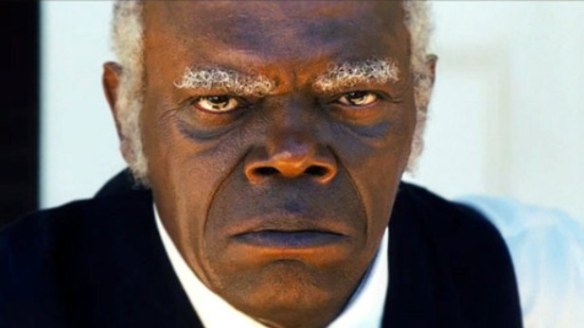
When Tarantino decided on DiCaprio to play the wildly charismatic antagonist, he dubbed the character, "The Boy Emperor". Baby face DiCaprio brings this chilling character to life with immense southern charm, quirky arrogance and a look which could make a flower wilt. Leo is helped along by a surprisingly strong performance from Samuel L. Jackson, who plays Candie's helpful and equally evil black servant. It appears Jackson, like Waltz, is also in his element when playing a showman under Tarantino. But this parrot mimicking servant is sure to rustle some feathers as he enjoys calling his fellow African-Americans "niggers", "motherfuckers" and "bitches". In fact, when Stephen isn't sitting on the shoulder of Candie, he's giving everyone the kind of eye popping, "nigger hating" look you'd expect from a crusty old white gent from the time.

The flower has wilted!

The 'nigger on a horse' look.

Django Unchained will give middle America nightmares, but is that a bad thing? Tarantino continues to use his winning formula of dark humor and grotesque violence to shock audiences and make us laugh at otherwise serious subjects. Nothing demonstrates this mixture better than the hilarious KKK scene, where Don Johnson, Jonah Hill and their band of merry racists squabble over their white-bagged fashion choice well into the night. 

The film didn't reach the heights of Inglourious Basterds, partly because of it's long winded linear structure, which leaves audiences wanting Tarantino's nonlinear array of tricks. Yet like his previous film, Tarantino shows that he can still bring history to life in a way which most other filmmakers would never even dream of.


8/10